

How to Choose the Best Data Governance Tool for Your Organization in 2026
Cut risk and costs with the right data governance tool in 2026
Choosing a data governance tool for 2026 is no small task. With so many vendors offering overlapping features, the challenge is finding the platform that best aligns with your business strategy, culture, and risk posture. To help you invest with confidence, we’ll guide you through the essential capabilities, First San Francisco Partners' (FSFP) proven 10-step evaluation framework, and provide an at-a-glance overview of leading tools. You’ll also see how governance connects to AI readiness and platforms like Salesforce, plus how to build a strong business case for investment.
Why Data Governance Platforms Matter More Than Ever
The data landscape today is anything but simple. Generative AI is driving an explosion of new digital assets where autonomous agents are now acting on business-critical systems, and regulatory requirements continue to expand across industries. So, without strong governance guardrails, organizations risk compliance failures, data breaches, and analytics that can’t be trusted.
Spending on data governance software reflects this urgency. In fact, Gartner projects worldwide IT spending will reach $5.61 trillion in 2025 alone, with software accounting for $1.24 trillion of that total. Data governance platforms sit within that software growth, as the demand for trusted governance will only intensify as AI becomes embedded in board-level strategy.
Take Salesforce as an example. As AI-driven automations touch customer and revenue data, machine-readable policies and fine-grained controls become non-negotiable. With FSFP’s Semantic Intelligence, policy metadata and semantic definitions are embedded into Salesforce, ensuring all automated actions comply with privacy, security, and business rules.
The Must-Have Capabilities Checklist
Before you dive into vendor comparisons, start with a litmus test. Any tool worth considering in 2025 should cover these five essential capabilities.
Metadata & Catalog
A governance platform without a robust metadata catalog leaves you flying blind. Look for solutions that provide a semantic layer and business glossary, so business and technical users can align on shared definitions, track data assets, and accelerate discovery.
End-to-End Lineage
With regulators requiring more transparency and AI models demanding traceability, field-level lineage is now table stakes. The ability to track a data element from its origin to the dashboard builds trust and supports compliance.
Data Quality & Observability
Business stakeholders require confidence that analytics and AI outputs are based on reliable data, making real-time monitoring critical. Tools should provide rule-based checks, anomaly detection, and ML-powered profiling to surface issues before they cascade across systems.
Policy & Access Control
Broad, role-based access is no longer enough. Modern governance platforms must deliver fine-grained entitlements, automated policy enforcement, and audit-ready controls that adapt dynamically as regulations evolve.
AI Readiness
Large Language Models (LLMs) and vector databases have added new governance dimensions. Look for tools that support AI guardrails, vector store integration, and semantic intelligence connectors that enable policies to extend seamlessly into AI-driven environments.
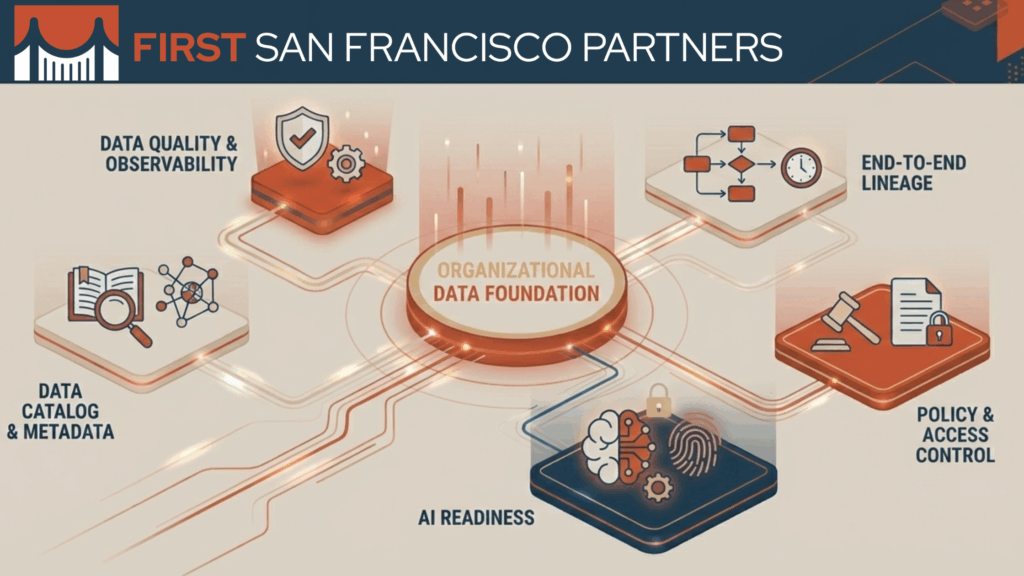
Data Governance Capabilities Checklist
FSFP's 10-Step Evaluation Framework
At FSFP, we’ve developed a structured, proven framework to help organizations choose the right governance platform —one that fits both their immediate needs and long-term strategy.
- Understand Business Outcomes
Start with problems, not products. Are your stewards struggling with glossary sprawl? Are compliance deadlines slipping? These outcomes drive requirements. - Assess Current Maturity
FSFP begins with a quick-win diagnostic, a focused assessment that identifies gaps in your current governance practices, tools, and processes. This helps identify immediate opportunities for improvement while also setting a realistic baseline for tool selection and long-term planning. - Define Weighted Criteria
Prioritize what matters most: scalability, user experience, AI guardrails, or total cost of ownership (TCO). - Market Scan
Narrow the list by combining public ratings with direct demo sessions. FSFP often pairs this research with “secret-shop” demos, testing how tools actually perform in practice, how intuitive they are for end users, and how well they align with your environment before moving forward. - Proof of Concept (PoC)
FSFP often recommends conducting a four-week proof of concept (PoC) to test whether a tool works with your data and environment. The PoC helps validate the tool's capabilities, ease of implementation, and performance in real-world scenarios. - Stakeholder Workshops
Involve stewards, IT, and business users throughout the tool selection process to ensure buy-in and alignment with business needs. We often hear reactions like, “This workflow finally reflects how we actually work.” - Cost-Benefit Analysis
Compare projected annual costs against tangible savings, risk avoidance, and efficiency gains. FSFP provides a cost-benefit analysis to help clients understand the total cost of ownership (TCO) and the potential return on investment (ROI) for each tool. - Decision Support
When it’s time to choose, FSFP uses a RACI-driven scorecard to make the process transparent and collaborative. Each criterion (scalability, usability, or integration) is scored with clear ownership across stakeholders: who is Responsible, Accountable, Consulted, and Informed. - Implementation Roadmap
Define a phased rollout plan with clear change-management and training steps. FSFP assists with implementation planning, including defining the implementation roadmap, resource requirements, and timelines. - Continuous Improvement
Governance isn’t one-and-done. FSFP’s managed services ensure your platform evolves with your business and regulatory environment.
2026 Tool Landscape at a Glance
The market is crowded, with dozens of vendors offering overlapping features. To help orient your search, here’s a high-level snapshot of leading governance tools.
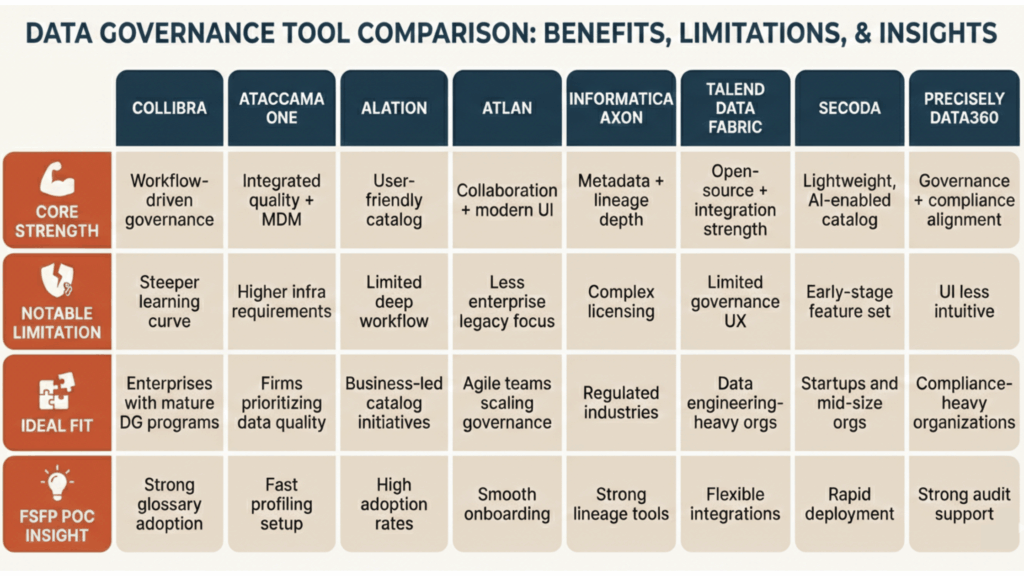
Data Governance Tool Comparison
Aligning Tool Choice with Semantic Intelligence and Salesforce Autonomous Agents
What sets FSFP apart is how we help clients go beyond checklists.
Our Semantic Intelligence approach maps ontologies directly to platform metadata models, ensuring that governance policies are consistent and machine-readable. This semantic foundation is crucial as AI agents and automated workflows continue to expand in enterprise systems.
Consider Salesforce; by embedding policy metadata into Salesforce objects, organizations can ensure autonomous agents act in alignment with governance rules. This applies to approving transactions, sharing customer data, or triggering downstream workflows. FSFP’s expertise bridges the gap between governance design and operational execution.
Building the Business Case: From TCO to ROI
Even the best tool won’t get funded without a solid business case. Decision-makers want to see not only the total cost of ownership (TCO) but also the return on investment (ROI). Here’s how to frame the investment.
Total Cost of Ownership (TCO):
- Annual licensing fees
- Cloud/infra costs
- Implementation and integration
- Training and enablement
- Ongoing support and upgrades
Value Drivers:
- Reduced regulatory fines through audit-ready lineage
- Faster analytics cycles with cleaner metadata
- Lower AI risk with embedded guardrails
- Operational savings from fewer manual data fixes
Licensing, infrastructure, and training may look significant upfront, yet they pale in comparison to the benefits. When framed correctly, governance tools shift from being a “compliance expense” to a strategic investment that safeguards trust and enables long-term efficiency.
Array