


Now you're being asked tougher questions: Are your AI models fair? Transparent? Aligned with your organization’s values?
This shift isn’t just technical — it’s strategic. Governance now needs to account for how AI behaves and what outcomes it produces. Understanding the differences between data governance and AI governance is key if you want to build systems that are both powerful and responsible.
Evolution from Data Governance to AI Governance
If you’re already managing data governance, AI governance is the next step, broadening the scope to address the unique risks and ethical questions that come with AI systems. It introduces critical elements such as fairness in algorithms, bias mitigation in training data, algorithmic transparency and comprehensive model monitoring and explainability strategies. This evolution, which unfolds through distinct stages of maturity, requires not only technological upgrades but also a fundamental change in your organization’s mindset about responsible data practices.
- Operational Data Governance: This initial stage focuses on maturing operational and transactional data capabilities. The emphasis is on establishing a solid foundation for data quality, consistency and security. A key element is building a data governance strategy that anticipates and supports future AI initiatives.
- Analytical Data Governance: Building on the operational foundation, this stage strengthens data governance and management capabilities to deliver reliable analytics across your business. The goal is to realize the strategic value of data by ensuring it is reliable, accessible and well-governed for advanced analytics and reporting.
- AI Strategy: A crucial step involves building executive literacy around AI, fostering a digital-first mindset and developing comprehensive strategies for AI adoption. This stage involves educating your leadership on the potential and implications of AI, as well as integrating AI considerations into strategic planning.
- AI Governance: The final stage involves expanding the existing data governance framework to design, build and implement an enterprise-level AI governance framework that is fully integrated with data governance. This includes establishing clear ethical guidelines, implementing robust risk management processes and ensuring compliance with relevant regulations.
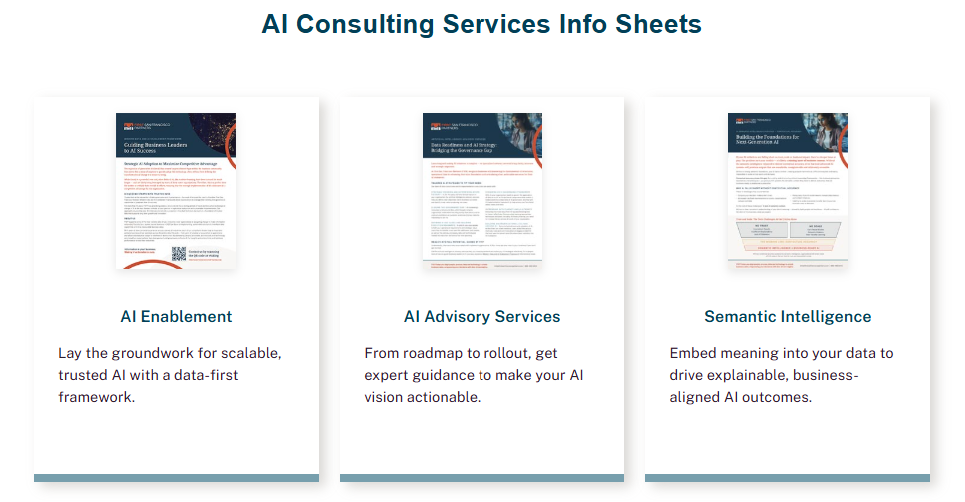
Get to know how First San Francisco Partners supports your AI initiatives. Download our informational sheets for more information.
Key Differences Between Data Governance and AI Governance
While interconnected, data governance and AI governance serve distinct purposes and focus on different aspects of your technological landscape. Data governance primarily manages the data lifecycle, ensuring quality, security and compliance across an organization's data assets. It's about maintaining the integrity and reliability of information, setting standards for data handling and ensuring regulatory adherence. Some of the main challenges data governance works to mitigate are data silos, inconsistent definitions and the ever-increasing volume of data.
AI governance, on the other hand, takes a broader view, overseeing the ethical, operational, and regulatory aspects of AI systems. It focuses on fairness, accountability and transparency in AI decision-making processes. This includes managing model bias, ensuring the explainability of AI outputs and aligning AI strategies with company goals.
While serving distinct purposes, there are similarities between the two, particularly in areas like metadata management, data quality monitoring, data lineage and versioning — all crucial for maintaining transparency and accountability in both data-driven and AI-driven processes.
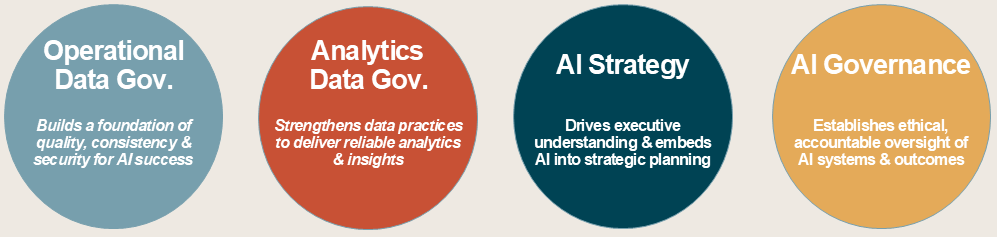
The path from data governance to AI governance unfolds in distinct stages — each building the foundation for responsible, scalable AI adoption.
Risk Management in AI Governance
When bringing AI-related risks into your organization's risk management, you need to keep an eye on some connected areas. On the technical side, you'll need to watch for models becoming less accurate over time (i.e., model drift), system reliability problems and how AI system failures might impact your business operations. Legal and ethical risks are just as crucial — you'll need to stay on top of AI regulations and data protection laws, handle issues around model bias and fairness, and make sure you can explain how your AI makes decisions.
Security is another critical element, from protecting against model attacks and data breaches to managing who can access and use your AI systems. Setting up a solid risk management approach helps you stay ahead of these potential problems by spotting and addressing them early, with clear plans for what to do if things go wrong. The key is getting your technical teams, business leaders and risk managers to work together and adapt their approach as your AI systems grow and change.
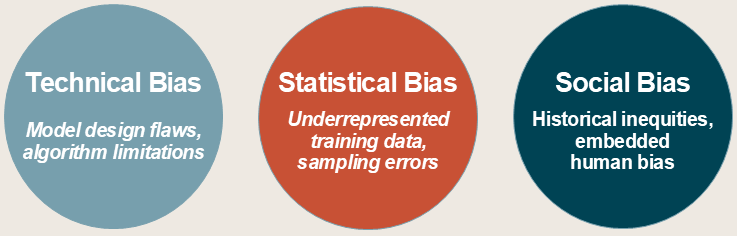
Understanding technical, statistical and social bias is essential for reducing AI risk and designing fair, trustworthy systems.
Addressing Bias in AI
While it may be impossible to entirely eliminate bias in AI systems, you can identify and reduce diverse types of bias that regularly appear, such as:
- Technical bias. This can crop up from computational issues in your models or how you design them.
- Statistical bias. This appears when your training data doesn't accurately represent the real-world scenarios you're trying to model.
- Social bias. Often the hardest bias to address, it can stem from historical inequities and human prejudices in training data or from design choices in the model itself.
To address bias in AI, run regular audits on your models, use specialized algorithms to detect and reduce unfair patterns, and set up ongoing monitoring systems to catch issues as they emerge. The key is to recognize that managing these risks isn’t a one-time fix but an ongoing process that requires constant attention from your team.
Governance Isn’t Optional — Let’s Get It Right
Data governance and AI governance are distinct but interconnected — both essential for building systems that are ethical, secure and effective. While data governance ensures the integrity and trustworthiness of your data, AI governance addresses the broader responsibilities of fairness, transparency and risk in AI decision-making.
Governance in this context isn’t just a compliance checkbox. It’s a critical capability that supports innovation while protecting your business, your customers and your reputation. Prioritizing both data and AI governance allows your organization to scale responsibly, navigate change with confidence and make AI a true business asset.
Ready to take the next step? Let’s talk about how FSFP can support your AI governance journey.