


Artificial intelligence is moving faster than most organizations can govern it. Data teams are fielding more decisions than ever, about what data to use, who owns it, how it's classified and whether it's trustworthy enough to power AI outputs. Without a structure to route and resolve those decisions, organizations risk what we call re-litigation: the same questions surfacing over and over, at the wrong levels, slowing down progress and eroding confidence in data assets.
The answer isn't more meetings or another policy document. It's a data decision framework. A scalable, structural foundation that defines how data governance decisions get made, owned and sustained across the enterprise.
What Is a Data Decision Framework and Why Does It Matter for AI Governance?
A data decision framework is the organizational infrastructure that determines who makes data-related decisions, at what level of authority, and through what process. It encompasses organizational structure, roles and responsibilities, a Data Governance Board charter and clearly defined escalation and reporting paths.
Think of it as the human and structural layer beneath your AI governance strategy. AI systems depend on governed, trusted data. But governing data at scale requires decisions, thousands of them. Without a framework, those decisions pile up, get made inconsistently, or never get made at all.
According to Gartner, 80% of organizations seeking to scale digital business will fail because they do not take a modern approach to data and analytics governance. A well-designed data decision framework is precisely that modern approach.
The Structural and Human Foundation of Data Governance
At First San Francisco Partners (FSFP), we design data decision frameworks grounded in lessons learned from an organization's own history: existing initiatives, past governance attempts and current decision-making patterns. This means the framework isn't theoretical; it's built to work within the realities of your organization.
The foundational work involves four critical components:
- Organizational Structure — Designing committees and communication forums that align with how the business actually operates, not an idealized org chart.
- Roles & Responsibilities — Clarifying accountability using a RACI model (Responsible, Accountable, Consulted, Informed) so that every type of data decision has a clear owner and a clear process. This is particularly important as AI use cases multiply and governance responsibilities expand across business and technical teams.
- Data Governance Board Charter — Documenting the purpose, scope, membership, and operating principles of the governing body so that leadership alignment is codified, not assumed.
- Escalation & Reporting Processes — Ensuring decisions are routed, made, and enforced at the right levels. One of the most overlooked aspects of data governance is determining the correct escalation triggers: the conditions under which a decision needs to move up the chain.
When these components are in place, the Data Governance Board can operate with clarity and authority from its very first session.
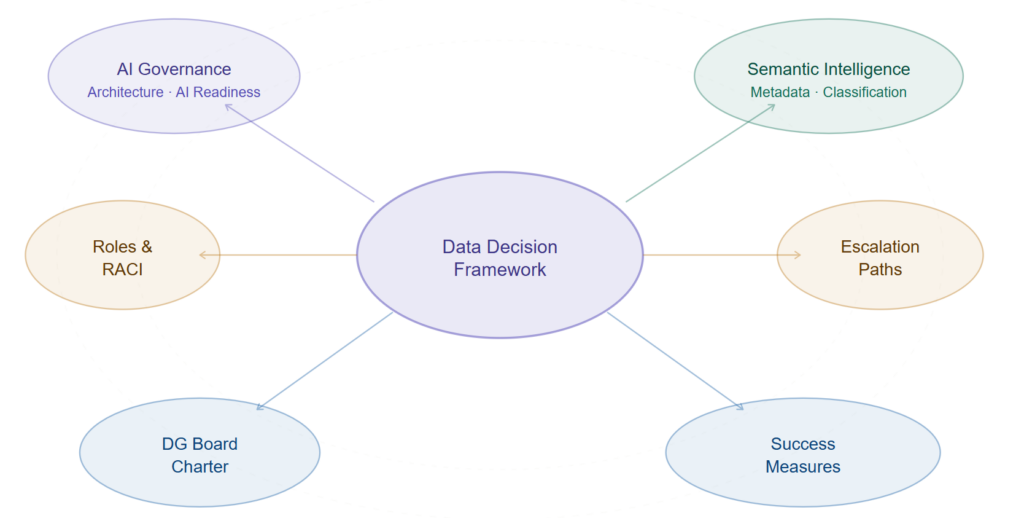
Data Decision Framework
How the Data Decision Framework Activates AI Governance and Semantic Intelligence
A data decision framework doesn't operate in isolation, it activates the workstreams that make AI governance and semantic intelligence possible.
Enabling AI Governance Through Data Governance
AI governance requires decisions about data architecture, the full data lifecycle, and AI readiness. These aren't one-time determinations; they're ongoing, high-stakes choices about which data is fit for AI use, how it's protected, and whether it meets the organization's minimum viable governance standard.
Without a data decision framework in place, these questions get escalated to the wrong people, stall in committee, or (most dangerously) get skipped altogether. With the framework activated, organizations can systematically compile and resolve the inventory of data decisions required to close the gap between their current governance state and what AI readiness actually demands.
Strengthening Semantic Intelligence
Semantic intelligence, the metadata, data classification and domain prioritization that gives data meaning, also depends on a functioning decision framework. Who owns a data domain? Who decides how an asset is classified? Who approves a metadata standard?
These questions require clear authority and accountability to answer at scale. The data decision framework provides exactly that. It enables organizations to close the gap between current metadata practices and the minimum viable state of data context required for AI systems to interpret and use data accurately.
Governed by Success Metrics
Both AI governance and semantic intelligence workstreams are most effective when they're tracked against meaningful outcomes. These outcomes impact metrics tied to organizational value, executive communication strategies and change management plans that sustain adoption. A data decision framework gives leadership the visibility to track progress and the structure to course-correct when needed.
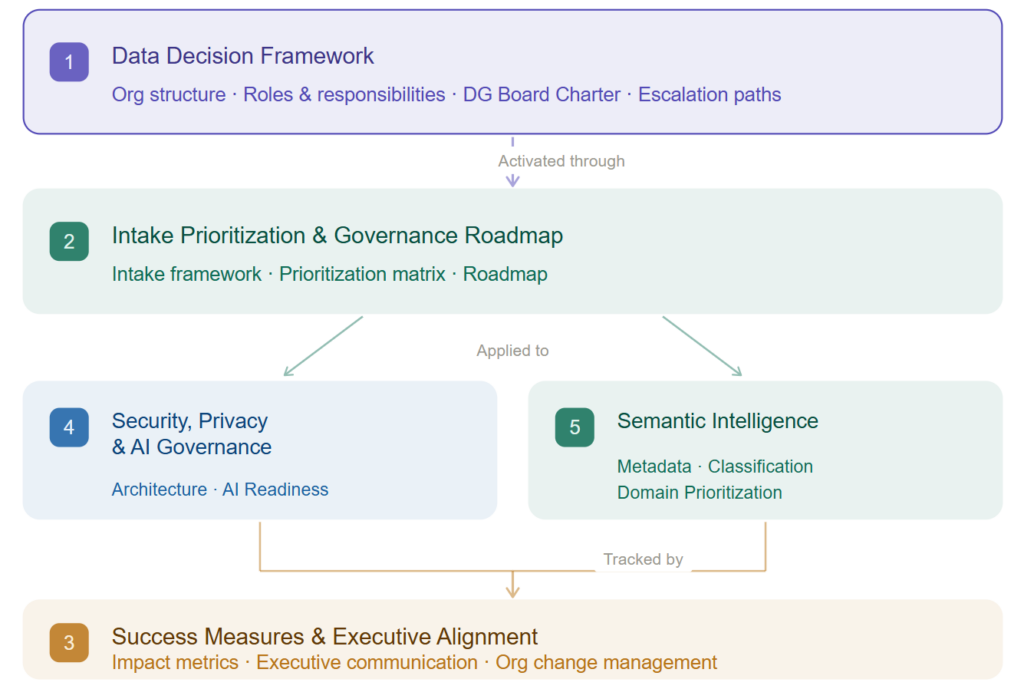
Data Decision Framework Flow Diagram
From Framework to Action: What Implementation Looks Like
Designing a data decision framework is not a theoretical exercise. The work is investigative and collaborative:
- Uncovering how decisions are currently made — examining real examples from active initiatives to understand what's working and what's creating friction.
- Identifying key decision-makers, stakeholders, and influencers — mapping the human network that data governance must work through, not around.
- Designing communication and escalation paths — building the connective tissue between governance layers so decisions don't get lost.
- Launching the Data Governance Board — including the inaugural session agenda and pre-communication materials that set expectations and generate early momentum.
The resulting framework is meant to be exercised, refined, and expanded. Phase 1 creates the structure; every subsequent phase strengthens it.
The Bottom Line: Data Governance Decisions Start with the Right Structure
Organizations that want to scale AI responsibly must first answer a foundational question: How do we make data decisions well?
A data decision framework answers that question. It establishes the structural and human foundation that makes data governance sustainable, AI governance actionable, and semantic intelligence scalable. It filters decisions to the right level of authority, prevents re-litigation, and gives leadership the confidence that data assets are being governed, not just managed.
At First San Francisco Partners, this is where we begin every engagement. Because the quality of your AI outcomes is only as good as the quality of the decisions behind your data.
Ready to assess your organization's data decision framework? Contact one of our AI experts to start the conversation.
Array