

AI Governance Consulting Services
Responsible AI Starts with Governance That Keeps Up
First San Francisco Partners (FSFP) helps enterprise organizations build the accountability structures, semantic intelligence and stewardship capabilities needed to govern AI responsibly at scale.
What is AI governance? AI governance is the organizing framework for establishing the strategy, people and processes needed for the responsible creation and management of AI solutions in support of organizational goals.
It is a combination of visibility, decision rights and controls that ensures AI aligns with business, risk and regulatory expectations.
AI governance turns AI ambition into accountable, repeatable, actionable decision-making. It covers:
- Use-case visibility and ownership
- Risk tiering and approval paths
- Ongoing oversight and escalation
- Evidence-based accountability, not just stated intent
- Ethical frameworks when regulation is missing

Strategy, People and Processes for Responsible AI
The Difference Between AI Governance and AI Enablement
These are two distinct — and equally important — disciplines. AI enablement is about accelerating adoption: helping your teams access AI tools, build capabilities and unlock value faster. AI governance is about accountability: ensuring those tools operate with oversight, transparency, ethical alignment and control. You need both — but they require different frameworks, different stakeholders and different conversations.

Central to effective AI governance is the semantic layer: the shared business definitions, data meanings and contextual intelligence that give AI systems the grounding they need to produce trustworthy, explainable outputs.
The semantic layer enables access controls in several different approaches, making the semantic layer critical for business value, compliance and risk. Without semantic intelligence, even well-governed AI can generate results that are technically fluent but contextually wrong.

AI Governance vs. Data Governance:
A Side-by-Side View
One of the most common misconceptions is that AI governance is simply data governance applied to model management. It isn’t. Although they diverge significantly, they do share the same structural DNA (decision rights, risk oversight, accountability), and are integrated for mutual benefits.
| Dimension | Data Governance | AI Governance |
|---|---|---|
| Purpose |
Organizing framework for managing enterprise data (such as information) across all its forms
Asset-focused |
Organizing framework for establishing strategy, people and processes for responsible AI solutions
Solution-focused |
| Scope |
Managing enterprise data assets — structured, semi-structured and AI-consumable data products
Data assets |
Responsible creation and management of AI solutions across their full lifecycle — including agentic systems
AI solutions |
| Key Mechanisms |
Policies, standards, accountabilities and technologies
Policy-driven |
Visibility, policies, decision rights and human-defined accountability structures
Human-centered |
| Decision Rights |
Who can access, define, classify or modify data assets across the enterprise
Data-centered |
Who can approve, deploy, monitor or retire AI models, agents and agentic solutions
Solution-centered |
| Risk & Oversight |
Risk identification and mitigation across the data lifecycle
Lifecycle scope |
Risk and ethics identification across the AI lifecycle — including business impact clarity, AI operating guidance and outputs of AI systems
Ethics + risk |
| Accountability |
Standards, directives and data stewardship — who is responsible for data quality, lineage and compliance
Standards-based |
Evidence and accountability beyond intent — audit trails, explainability documentation and bias assessments
Evidence-based |
| Semantic Layer |
Business glossaries, data definitions and semantic layer for shared understanding of data assets
Shared meaning |
Semantic intelligence that informs AI reasoning — internal knowledge governed via semantics; external knowledge governed via ethics and semantics
Contextual grounding |
| Value Delivered |
Trusted Data | Explainable Solutions |
Get AI Right — From the Start
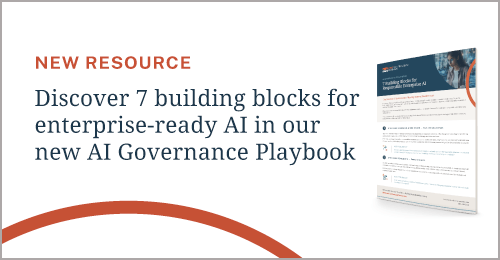
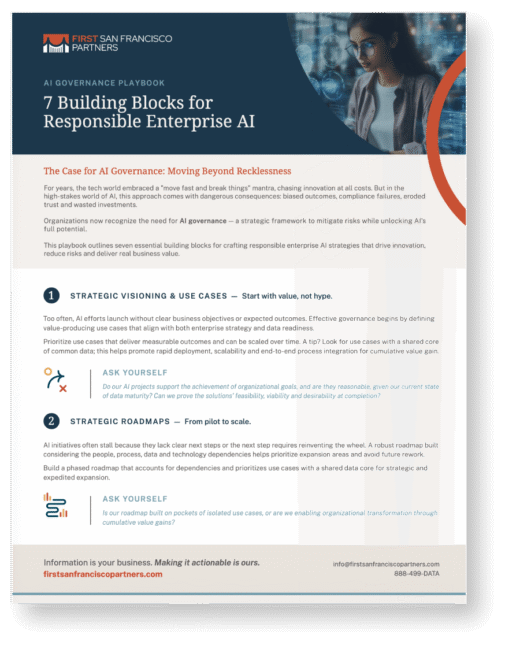
This free playbook from FSFP outlines a practical framework for responsible enterprise AI, helping organizations align use cases with business strategy and data maturity while building trust, transparency and ethical oversight across their models.
AI Governance Doesn’t Follow a Straight Line
Early assumptions were that data governance would simply branch off into AI governance as a clean extension from DG. The reality is more nuanced, and more demanding.
The initial belief: AI governance would become an appendage from data governance into AI governance, still connected but on a different path.
The correct model: Data governance evolves in service to AI. AI governance runs in parallel as a distinct, co-equal discipline.
As data governance matures, its scope expands: from critical data elements in operational settings, to datasets for analytics, to data sources and AI-consumable data products, such as metadata. Governance maturity increases both what is governed and who consumes it, both humans and AI systems alike.

Why this matters in practice:
In practice, your organization will need distinct strategies, policies and standards for each discipline, along with a roadmap, shared milestones and coordinated prioritization. The semantic layer is the connective tissue: semantic intelligence bridges both worlds, ensuring AI systems consume data with the same contextual grounding that your business stakeholders rely on.
- Data governance must extend from structured data to semi- and unstructured data, data sources and AI-consumable data products.
- AI governance introduces new metadata types (model provenance, bias assessments, training data lineage, explainability factors), with no equivalent in traditional data governance.
- The semantic layer must now serve both human analysts and AI reasoning engines, requiring richer, more contextually precise semantic intelligence than prior data governance ever required.
What Your Organization Needs to Succeed with AI
Addressing these three points will align your organization to the capabilities required to govern AI responsibly — and unlock its full competitive potential.
01 — AI Will Necessitate a DG Evolution
02 — Decisioning Will Be Refined
03 — Decision Stewardship Will Emerge
Governing AI Like a Co-Worker, Not a Database
Data governance was built to manage passive assets — records, schemas, definitions. You control what goes in; you set rules for access. The framework is relatively linear: define, catalog, steward, measure.
AI agents are fundamentally different. They don’t just store and retrieve — they reason, decide and act. An AI agent recommending a credit decision, drafting a customer communication or autonomously executing a business process is behaving more like a co-worker than a database. Governing a co-worker requires a completely different framework.
Traditional data governance asks: “Is the data accurate and accessible?” AI governance must ask: “Is this decision contextually valid, ethically grounded, explainable and aligned with our values?”

This is precisely why semantic intelligence and the semantic layer are so critical in an AI governance context.
Internal knowledge — the business context, definitions, rules, access, controls and meaning your organization has accumulated — must be structured and governed so AI systems can draw on it accurately. Without semantic grounding, AI outputs may be fluent but wrong. With it, they become genuinely trustworthy.
Take a consumer goods company for example. What does ‘customer’ mean and what is its hierarchy? Is it the ‘purchaser’, ‘owner’ or ‘gifter’? The difference matters: a data governance policy defines what ‘customer’ means in your CRM. AI governance must ensure that when an AI agent reasons about a customer, it applies that semantic intelligence — not a generic interpretation derived from its training data.

Decision Stewardship Defined
Decision Stewardship is the critical examination of decisions to ensure alignment to organizational values, societal ethics and government compliance. It ensures logical and explainable results that are grounded in the specificity of the enterprise yet expansive enough to create new opportunities leveraged for competitive advantage and growth.
Decision Stewardship Covers:
Human in the Loop
Verifying oversight checkpoints for high-stakes automated decisions
Reasoning
Evaluating whether AI logic is sound, traceable and contextually appropriate
Ethics Evaluation
Assessing AI behavior for bias, societal impact and value alignment
AI as a Co-Worker Assessments
Applying the same standards your organization expects from human employees
Semantic Grounding Validation
Ensuring AI reasoning is informed by your organization's semantic layer, not generic assumptions
Skills and background needed for a Decision Steward
(not exhaustive):
- Process, Data, Systems and Culture fluency
- Risk Tolerance calibration
- AI Native literacy
- Reasoning and Bias recognition
- Standards and Acceptable Deviation thresholds
- Quality testing and ML/AI Operations concepts
Why the Semantic Layer Is Central to AI Governance
In data governance, the semantic layer has long been the connective tissue between raw data and business meaning — the shared definitions, business glossaries and contextual rules that make data usable across the enterprise.
In AI governance, the semantic layer plays an even more critical role. AI systems — especially large language models and agentic solutions — consume both internal data and internal knowledge. That internal knowledge must be governed via semantics: structured, maintained and made accessible so AI systems can use it reliably.
External knowledge must similarly be governed through the lens of ethics and semantics — ensuring that what AI systems draw from outside your organization is evaluated against your values and your semantic standards before it influences decisions.

Four Metadata Types Under AI Governance Stewardship

Business
Business Metadata & Semantic Definitions
Data described in business terms — ownership, definitions, business rules — that AI systems need to contextualize their reasoning accurately within your enterprise. Tags: Data Definitions, Ownership, Business Rules.

Technical
Technical Metadata
Structural and system-level properties — schemas, formats, lineage, data types — that enable AI systems to trace the provenance of data feeding their outputs. Tags: Schema, Lineage, Data Types.

Operational
Operational Metadata
Usage logs, job history and performance metrics that enable continuous monitoring of AI behavior — how systems are being used and whether they're performing within governed bounds. Tags: Usage Logs, Job History, Performance.

AI — New
AI Metadata
Model provenance, training data documentation, bias assessments and explainability factors. User prompts, tool calls and decision confidence scores — all requiring active semantic intelligence governance to produce evidence-based accountability. Tags: Model Provenance, Bias Tracking, Explainability.
How Data Governance and AI Governance Work Together
Both disciplines are necessary. They share structural convergence points — particularly through the Data Decision Framework — but require distinct strategies, separate stewardship committees and their own policies and standards. The goal is integration, not duplication.
| Data Governance — Evolves in Service to AI, while maintaining traditional DG principles | AI Governance — Runs in Parallel, Not Instead |
|---|---|
|
|
Shared convergence point: the Data Decision Framework (DDF). Single roadmap, shared milestones, coordinated priorities.
How FSFP Supports Your AI Governance Program
Our engagements range from strategy and program design to ongoing managed services. We meet you where you are — and build toward where AI governance needs to take your organization.
AI Governance Strategy & Roadmapping
We assess your current state, define your AI governance vision and co-create a prioritized roadmap aligned to your data governance maturity, business goals and risk profile.
AI Risk Tiering & Use-Case Governance
We build frameworks for cataloging AI use cases, assigning risk tiers, establishing approval paths and maintaining the ongoing oversight visibility AI requires at scale.
Decision Stewardship Design
We help you define and operationalize the Decision Steward capability — the human-in-the-loop function that validates AI decisions for context, ethics, reasoning quality and organizational alignment.
Semantic Layer & AI Metadata Governance
We extend your semantic intelligence infrastructure to support AI consumption — governing internal knowledge, AI metadata (model provenance, bias tracking, explainability) and the semantic grounding AI systems need to produce trustworthy results.
AI Governance Operating Model
We design the committee structures, accountability frameworks and cross-functional working groups that align data governance and AI governance into a single, coordinated model — distinct strategies, shared roadmap.
Agentic AI Governance
Governing AI agents — systems that reason and act autonomously — requires a framework beyond traditional data governance. We establish the oversight, ethics evaluation and co-worker assessment protocols that agentic solutions demand.
AI Governance Measurement & Monitoring
We establish the KPIs, monitoring cadences and evidence-based accountability mechanisms that turn AI governance from a compliance checkbox into a continuously improving enterprise capability.
AI Governance as a Managed Service
For organizations that need sustained support (such as Fractal Consulting – filling a temporary gap for employment), FSFP offers managed AI governance services — bringing expert stewardship, program management and semantic intelligence oversight without building it entirely in-house.
Data Governance Integration
We ensure your data governance program evolves in service to AI — extending your semantic layer, expanding stewardship and connecting data governance outcomes directly to AI governance requirements.
Practical Starting Points for Your AI Governance Journey
AI governance doesn’t require a perfect data governance program as a prerequisite — but it does require honest assessment, deliberate structure and a willingness to govern something that behaves like a co-worker rather than a data asset.


If your data governance program is perceived as slow, bureaucratic or isolated, that perception can carry over to AI governance. Reframe it as an enterprise service that enables and accelerates AI — and articulate the clear, relevant connection between governance maturity and AI readiness.

Most organizations already have AI solutions in production. Invite those teams to the table first. Your data science team has guidelines and best practices that can jump-start your program — AI governance wasn't invented in 2023. If you don't find a seat at the table for this community, prepare to battle shadow AI.

AI is most effective as a co-worker. Apply the same ethical standards and non-negotiables to AI systems that your organization expects from its employees. What values, behaviors and boundaries need to be codified into your AI solutions to ensure they act in the organization's best interests?

AI is being added to nearly every enterprise application. Create a catalog of what's being tested, promoted or deprecated across your tool stack. Giving stewards visibility into the full picture creates participation and validity — and gives app owners a reason to engage with responsible AI governance.

AI governance isn't only about risk mitigation. Use process mapping to identify decision points where AI can be empowered to act — building enterprise momentum. Those same process maps reveal the critical data that needs to be governed, creating a clear connection back to your data governance program.

Before scaling AI, ensure your semantic layer can support it. AI systems without access to governed semantic intelligence — your business definitions, contextual rules and data lineage — produce outputs that are plausible but not reliably grounded. Semantic governance is the foundation of explainable AI.
What Every AI Governance Leader Should Know
- Data governance evolves in service to AI — it does not become AI governance. Both disciplines must run in parallel.
- The Data Decision Framework (DDF) is the convergence point where both frameworks align on a shared foundation.
- Integration is necessary; redundancy is not. Identify shared elements deliberately — govern the new ones with rigor.
- AI carries higher governance risk due to automated, human-removed decision-making. Oversight must reflect this elevated risk.
- Decision Stewardship is a unique new capability that must be deliberately instantiated — it will not emerge on its own.
Enterprise Governance Framework for AI Readiness
A global healthcare organization needed enterprise readiness for analytics and AI. Over a multi-year engagement, we revitalized the data catalog, expanded stewardship, embedded governance into ERP and improved metadata, lineage and automation for AI readiness — establishing an enterprise governance framework and improving data trust.
Read more about this success story.

AI Governance Consulting Services Info Sheets
AI Enablement
Lay the groundwork for scalable, trusted AI with a data-first framework.

AI Advisory Services
From roadmap to rollout, get expert guidance to make your AI vision actionable.
Semantic Intelligence
Embed meaning into your data to drive explainable, business-aligned AI outcomes.
FAQs about AI Governance Consulting Services
AI governance is the organizing framework for establishing the strategy, people and processes needed for the responsible creation and management of AI solutions in support of organizational goals. It combines visibility, decision rights and controls to ensure AI aligns with business, risk and regulatory expectations, turning AI ambition into accountable, repeatable, actionable decision-making.
Although they share the same structural DNA (decision rights, risk oversight and accountability), they diverge significantly in scope and purpose:
Data Governance: An asset-focused framework for managing enterprise data across all its forms, including structured, semi-structured and AI-consumable data products.
AI Governance: A solution-focused framework for the responsible creation and management of AI solutions across their full lifecycle, including agentic systems.
Decision Rights: Data governance defines who can access or modify data assets. AI governance defines who can approve, deploy, monitor or retire AI models and agents.
Accountability: Data governance is standards-based. AI governance is evidence-based, requiring audit trails, explainability documentation and bias assessments.
Data governance evolves in service to AI, while AI governance runs in parallel as a distinct, co-equal discipline.
A Decision Steward is a new accountability role at the intersection of AI governance and organizational responsibility. This capability critically examines AI-generated decisions for alignment to organizational values, societal ethics and regulatory compliance, verifying human-in-the-loop checkpoints, evaluating AI reasoning, assessing bias and treating AI agents with the same behavioral accountability expected of any co-worker. Decision Stewardship will not emerge on its own. It must be deliberately instantiated as AI scales across your organization.
Our engagements range from strategy and program design to ongoing managed services, meeting you where you are. We help with:
AI Governance Strategy & Roadmapping: Assessing current state, defining vision and co-creating a prioritized roadmap.
AI Risk Tiering & Use-Case Governance: Cataloging AI use cases, assigning risk tiers and establishing approval paths.
Decision Stewardship Design: Defining and operationalizing the human-in-the-loop function that validates AI decisions.
Semantic Layer & AI Metadata Governance: Extending semantic intelligence to support AI consumption and explainability.
Agentic AI Governance: Establishing oversight, ethics evaluation and co-worker assessment protocols for autonomous systems.
AI Governance as a Managed Service: Sustained expert stewardship without building entirely in-house.
These are two distinct (and equally important) disciplines. AI enablement is about accelerating adoption: helping your teams access AI tools, build capabilities and unlock value faster. AI governance is about accountability: ensuring those tools operate with oversight, transparency, ethical alignment and control. You need both, but they require different frameworks, different stakeholders and different conversations.
AI systems, especially large language models and agentic solutions, consume both internal data and internal knowledge. Without semantic grounding, even well-governed AI can generate results that are technically fluent but contextually wrong. The semantic layer provides the shared business definitions, contextual rules and data meanings that AI systems need to reason accurately within your enterprise. With governed semantic intelligence, AI outputs become genuinely trustworthy and explainable.
No. AI governance doesn’t require a perfect data governance program as a prerequisite, but it does require honest assessment, deliberate structure and a willingness to govern something that behaves like a co-worker rather than a data asset. In fact, most organizations already have AI solutions in production, and your data science team likely has guidelines and best practices that can jump-start your program. The two disciplines should run in parallel from a single roadmap with shared milestones.
Want To Learn More About AI Governance?
Ready to Build Your AI Governance Program?
Whether you're starting from zero or evolving a mature data governance program, FSFP brings the frameworks, experience and semantic intelligence expertise to help you govern AI responsibly.
Contact us today to speak with an AI expert.